



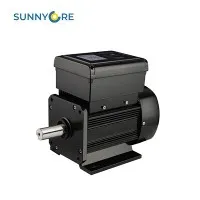
220v Synchronous Motor
Synchronous motors are those that have a constant rotational speed. They operate at the supply's synchronous speed. They are commonly utilized to improve the power factor by operating at a constant speed under no-load conditions.
Your Leading Taizhou Inwon Technology Co.,Ltd. Supplier
Taizhou Inwon Technology Co.,ltd is a professional enterprise in the production of water pumps. Located in Daxi Town, Wenling Taizhou City, Zhejiang of China, which is well known as"Hometown of Water Pump".
Taizhou Inwon Technology Co.,ltd is engaged in various kinds of high quality permanent magnet variable frequency water pumps, such as booster pumps, self priming pumps, multi-stage pumps, shield circulation pumps, motors, etc.
As the innovator and leading manufacturer of Automatic permanent magnet variable frequency water pumps and motors in China, we always keep excellence and make progress constantly.
Our mission is to provide the best reliable quality permanent magnet variable frequency water pump and motor at competitive price to meet our customers.
Why Choose Us?
High quality
Our products are manufactured or executed to very high standards, using the finest materials and manufacturing processes.
Competitive Price
We offering a higher-quality product or service at an equivalent price. As a result we have a growing and loyal customer base.
Rich experience
Our company has many years of production work experience. The concept of customer-oriented and win-win cooperation makes the company more mature and stronger.
Global shipping
Our products support global shipping and the logistics system is complete, so our customers are all over the world.
After-sale service
Professional and thoughtful after -sales team, let you worry about us after -sales Intimate service, strong after -sales team support.
Advanced equipment
A machine, tool or instrument designed with advanced technology and functionality to perform highly specific tasks with greater precision, efficiency and reliability.

High Speed Permanent Magnet Motor
This high speed permanent magnet motor is with inverter, it's all-in -one machine, the speed is adjustable, can be widely used in various industries

Variable Frequency Drive AC Motor
This variable frequency drive AC motor is designed to optimize parts' performance, energy saving, high efficiency, It is widely used in agricultural machinery industry.

Variable Speed Drive For Single Phase Motor
Variable speed drive for single phase motor has the advantages of simple structure, small size, high efficiency, and high power factor. It has been widely used in the metallurgical industry, ceramic industry, rubber industry, petroleum industry, textile industry and other industries in the medium and low voltage motor.

Permanent Magnet Variable Frequency Motor
This is adjustable speed permanent magnet variable frequency motor, easy to maintain, can be used for all ranges power tools, e.g. drills, hammers, etc.

This 220V synchronous motor is with permanent magnet conversion frequency technology, all copper motor, low noise, high efficiency, wide range of application, like corn thresher, the blender, etc.

3 Phase Permanent Magnet Motor
It's a 3 phase permanent magnet motor, can be used for industrial drills and hammers.

Adjustable Speed Permanent Magnet Motor
This is all in one adjustable speed permanent magnet motor with inverter. Can be used for polishers and saws.

This 3 phase AC synchronous motor can is with permanent magnet variable technology, mainly for machine tools, Public life, industrial machines.
What is 220v Synchronous Motor?
Synchronous motors are those that have a constant rotational speed. They operate at the supply's synchronous speed. They are commonly utilized to improve the power factor by operating at a constant speed under no-load conditions. At a given rating, synchronous motors lose less energy than induction motors.
1.High efficiency
Synchronous motors have a unique and merited position as the most efficient electrical drive in industry.They perform with great economy while converting electrical power to mechanical power and can be built with unique physical features.Synchronous motors can be designed to effectively operate over a wide range of speeds to provide the best drive for a wide variety of loads.
2.Power factor correction
Because they can operate at leading power factors, synchronous motors can help reduce your power costs and improve efficiency of the power system by correcting low power factor. In a few years, savings in power bills may equal the original investment in the motor.
3.Reduced maintenance
Synchronous motors with brushless exciters practically eliminate the need for motor maintenance other than routine inspection and cleaning.
4.Space savings
Engine-type synchronous motors can be connected directly to the shaft and bearings ofthe driven equipment.This approach saves on floor space, extra building costs, and makes for a simple installation.
5.Constant speed means better quality products
Synchronous motor speed is unaffected by line or load conditions. In certain applications, e.g.paper mill pulp machines, constant speed operation results in superior uniformity and quality of the product being produced.
6.Adjustable speed means lower power costs
In many cases it is much more economical to operate driven equipment at reduced speeds.This can be accomplished using synchronous motors in conjunction with magnetic drives, or through electronic methods, which can be used to supply an adjustable frequency to the machine and control its operating speed.Typical applications for adjustable speeds include pumps and fans.Either approach can reduce power costs and provide a more cost-effective process.
7.Synchronous motors can operate over a wide range of power factors, including hysteresis and overrunning.
8.They can be constructed with a wider air gap than induction motors, which makes these motors more mechanically stable.
9.Synchronous motors are less costly in certain kW and speed ranges. They typically operate at higher efficiencies at low speeds with uniform power factors.
10.It can be constructed with a wider air gap than an induction motor, which allows it to be mechanically stroked.
11.Over-excited synchronous motors can have an over-excited power factor and can be operated in parallel with induction motors and other lagging power factor loads, thus improving the system power factor.
12.In synchronous motors, the speed remains constant regardless of the load. This characteristic helps industrial drives.
13.Compared to induction motors, synchronous motors usually operate at higher efficiency.
Types of 220v Synchronous Motor
Nonexcited motors
Manufactured in reluctance and hysteresis designs, these motors employ a self starting circuit and require no external excitation supply. Reluctance designs have ratings that range from sub fractional to about 30 hp. Sub fractional horsepower motors have low torque, and are generally used for instrumentation applications. Moderate torque, integral horsepower motors use squirrel- cage construction with toothed rotors. When used with an adjustable frequency power supply, all motors in the drive system can be controlled at exactly the same speed. The power supply frequency determines motor operating speed.
Hysteresis motors are manufactured in sub fractional horsepower ratings, primarily as servomotors and timing motors. More expensive than the reluctance type, hysteresis motors are used where precise constant speed is required.
DC-excited Motors
Made in sizes larger than 1 hp, these motors require direct current supplied through slip rings for excitation. The direct current can be supplied from a separate source or from a DC generator directly connected to the motor shaft.
Synchronous motors, either single or polyphase, cannot start without being driven, or having their rotor connected in the form of a self-starting circuit. Since the field is rotating at synchronous speed, the motor must be accelerated before it can pull into sync. Accelerating from zero rpm requires slip until syncing is reached. Therefore, separate starting means must be employed.
In self-starting designs, fractional horsepower motors use methods common to induction motors (split phase, capacitor-start, and shaded pole). The electrical characteristics of these motors cause them to automatically switch to synchronous operation.
Although DC-excited motors have a squirrel-cage for starting, the inherent low starting torque and the need for a DC power source requires a starting system that provides full motor protection while starting, applies DC field excitation at the proper time, removes field excitation at rotor pullout, and protects the squirrel-cage winding against thermal damage under out-of-step conditions.
Application of 220v Synchronous Motor
- An overexcited synchronous motor runs at leading power factor and takes leading current from the sink bar, so it can be used to improve the power factor of the overall installation.
- Synchronous motors are also used to regulate the voltage at the end of the transmission line.
- Typical applications for high speed synchronous motors are fans, blowers, pumps and compressors.
- Since synchronous motors can have speeds as low as 120 RPM, they are ideal for direct connection to reciprocating compressors.
- Pulp mixers and mills, steel and metal mills, rock and ore crushers are often connected to motors or geared.

Frame
Supports and protects the motor; it is built in horizontal and vertical types and in various protective constructions for indoor or outdoor service.
Stator
Consists of the stationary magnetic parts, including the core and winding which operate off the alternating current power supply to provide a rotating magnetic field.
Rotor
Consists of the rotating active parts, and includes the spider, the field-pole winding and the amortisseur winding.field poles are magnetized by direct current from the exciter or directly through collector rings and brushes; they interlock magnetically through the air-gap and revolve in synchronism with the rotating magnetic poles of the stator.
Exciter
Supplies magnetizing current to the field winding. Modern exciters are of the rotating brushless type with no collector rings or brushes.
Amortisseur winding
Makes a synchronous motor self-starting like a squirrel-cage induction motor.Depending on the type of loads and the torque required, a variety of bar materials and arrangements can be used to provide adequate starting torque.
Top Tips for Maintaining Electric Motors
Develop a general maintenance and cleaning routine
Every company should have a cleaning routine in place if they don't already. Simply keeping your motor clean can significantly improve its performance and lifespan. Your motor should never have excessive grease, dust, or other debris on or in any of its parts. Dust is a common culprit for overheating because of poor air circulation. While cleaning up the motor, take the extra time to examine the rest of the motor. Ensure your couplings are tightened, the belt has the appropriate tension, and there's no corrosion in sight.
Check the motor's lubrication
Believe it or not, it's absolutely possible to overlubricate a motor, which can lead to internal problems. However, your motor needs lubricant to operate at peak performance level. Each electric motor requires different amounts of lubricant. That said, we would suggest checking the manufacturer's manual. The manufacturer can best provide the intervals and amounts of lubricant for their motor to operate at its best. Lubricating the motor too early or too late can result in premature wear and tear. Additionally, manufacturers typically recommend a specific lubricant that's designed for their motor. It's important to use the suggested lubricant; otherwise, you could risk voiding a manufacturer's warranty.
Regularly inspect the bearings
The motor's bearings experience some of the most wear and tear, so it's only natural to expect them to cause issues from time to time. Much of the preventative measures you can take we've already discussed, such as general maintenance and keeping the motor clean. However, bearings can go bad for several other reasons. To avoid bearings wearing out earlier than they should, you first must assure the motor is aligned properly. Misalignment can significantly strain one or both of the bearings. Furthermore, improper lubrication can also cause your bearings to wear out sooner than they should. One common red flag that a bearing has gone bad is an overheating motor. Each motor has a different working temperature, so it's important to read the manufacturer's manual to find your motor's recommended temperature. All that said, there is one factor to consider when inspecting your bearings and motor as a whole––and that's vibration. In most cases, you merely need new bearings, which is normal as they're essentially consumables since they wear out over time. However, to extend the life of your bearings, sometimes you need to change to a different type of bearing. Many of you probably have shielded bearings when you could be using open or sealed bearings. As always, it's best to find out if the manufacturer of your motor suggests such bearings prior to installation.
Reduce or eliminate vibrations
Every motor is going to vibrate to some extent, but excessive vibration can cause serious damage––potentially permanently––to your electric motor. The moment you notice your motor is vibrating more than usual, you should turn off the motor and find the source of the vibration. The source is usually a mechanical issue such as misalignment, a worn-out bearing, or belt tension that is too high. You could remove the belt and then do a test run to see if the motor is still vibrating. On the other hand, the cause of the problem could be your power source, which is a more serious concern. The bottom line is, in order to avoid excessive vibrations, you need to ensure proper alignment and that the bearings are in good condition.
Inspect the rotor and stator
Some call the rotor and stator "the heart of your motor," and rightfully so. The rotor and stator are the essential components to the motor; if you take one of them away, you won't have an operating motor. You'll want to measure any gaps around these components and measure the diametrical clearance. The diametrical clearance measures free movement in the inner and outer race mounts. Your clearance can vary depending on your motor and the bearings.
The principle of operation of a synchronous motor can be understood by considering the stator windings to be connected to a three-phase alternating-current supply. The effect of the stator current is to establish a magnetic field rotating at 120 f/p revolutions per minute for a frequency of f hertz and for p poles. A direct current in a p-pole field winding on the rotor will also produce a magnetic field rotating at rotor speed. If the rotor speed is made equal to that of the stator field and there is no load torque, these two magnetic fields will tend to align with each other. As mechanical load is applied, the rotor slips back a number of degrees with respect to the rotating field of the stator, developing torque and continuing to be drawn around by this rotating field. The angle between the fields increases as load torque is increased. The maximum available torque is achieved when the angle by which the rotor field lags the stator field is 90°. Application of more load torque will stall the motor.
Starting Methods
Above a certain size, synchronous motors cannot self-start. This property is due to rotor inertia; it cannot instantly follow the rotation of the stator's magnetic field. Since a synchronous motor produces no inherent average torque at standstill, it cannot accelerate to synchronous speed without a supplemental mechanism.
Large motors operating on commercial power include a squirrel-cage induction winding that provides sufficient torque for acceleration and also serves to damp motor speed oscillations. Once the rotor nears the synchronous speed, the field winding becomes excited and the motor pulls into synchronization. Very large motor systems may include a "pony" motor that accelerates the unloaded synchronous machine before load is applied.
Electronically controlled motors can be accelerated from zero speed by changing the frequency of the stator current.
Small synchronous motors are commonly used in line-powered electric mechanical clocks or timers that use the power line frequency to run the gear mechanism at the correct speed. Such small synchronous motors are able to start without assistance if the moment of inertia of the rotor and its mechanical load are sufficiently small. The motor accelerates from slip speed to synchronous speed during an accelerating half cycle of the reluctance torque. Single-phase synchronous motors such as in electric wall clocks can freely rotate in either direction, unlike a shaded-pole type.
Taizhou Inwon Technology Co.,ltd is a professional enterprise in the production of water pumps. Located in Daxi Town, Wenling Taizhou City, Zhejiang of China, which is well known as "Hometown of Water Pump".

FAQ
Q: What is the maintenance of a synchronous motor?
Q: What causes the synchronous motor to to fail?
Q: What is the problem of synchronous motor?
Q: Is synchronous motor AC or DC?
In a synchronous motor, AC power is supplied to the stator to generate a rotating magnetic field. DC power is supplied to the rotor which results in discrete North (N) and South (S) poles.
Q: How do you excite a synchronous motor?
Q: How do you slow down a synchronous motor?
Q: What happens when excitation of synchronous motor fails?
Q: How do I know if my synchronous motor is bad?
Q: Can synchronous motor be reversed?
Q: What happens when a synchronous motor loses synchronization?
Q: How do you make a synchronous motor self start?
Q: What is the rpm of a synchronous motor?
Q: How do you increase active power in a synchronous motor?
Q: Which exciter is essential to run a synchronous motor?
Q: Can synchronous motor start by itself?
Q: How do I change my synchronous speed?
Q: How do you control the reactive power of a synchronous motor?
Q: Does a synchronous motor need a capacitor?
Q: What happens when a synchronous motor is overloaded?
Q: How can you tell if a motor is short-circuited?
Hot Tags: 220v synchronous motor, China 220v synchronous motor manufacturers, suppliers, factory, Multistage Booster Pumps, High Suction Self Priming Pump, Shielding Circulating Pump, Magnetic Drive Circulation Pump, Self Priming Electric Pump, Multi Stage Pressure Booster Pump




Send Inquiry
